Cart
0
Sizing Guide
How to Measure Ring Size at Home: The Methods That Work and the Ones That Do Not
Three reliable ways to get it right, how to size a surprise gift, and why the same finger changes size through the day.
What This Guide Covers
- Why sizing matters more on made to order rings
- The most accurate method: measure a ring she owns
- The string or paper strip method
- Printable sizers and why they often fail
- Ring size conversion chart
- When to measure, and why it changes
- How band width changes the size you need
- Sizing a surprise gift without asking
- What to do if you are between sizes
- Resizing after the fact
- Frequently asked questions
Learning how to measure ring size at home is straightforward. Doing it at the wrong time of day, on the wrong finger, with the wrong method is what produces a ring that does not fit.
A ring is the only piece of jewelry where a small error is unwearable. A necklace two inches off still goes around the neck. A ring half a size too small does not go on at all, and half a size too large works its way off a hand at some point you will not notice until it is gone.
Every ring we make is sized during production rather than adjusted afterward, so the number you give us is the ring you receive. This guide is how to arrive at that number with confidence.
Why sizing matters more on made to order rings
A mass produced ring sitting in a case can be swapped for the next size up. A personalized ring cannot, because it was made for one person and cannot be resold to anyone else.
That changes the stakes of the measurement. It is worth ten extra minutes and a second check. It is also why personalized rings, like everything else we make, are generally not returnable except for damage or a defect.
The good news is that solid gold and sterling silver both resize cleanly, so a mistake is correctable by a jeweler. It costs time and money, but it is not a ruined piece.
The rule of thumb. A ring should slide on with light resistance and take a small amount of effort to come back over the knuckle. If it spins loosely or comes off without any resistance at all, it is too big. If you have to force it past the knuckle, it is too small.
The most accurate method: measure a ring she owns
This is the method we recommend above all others, and it is the only one we consider reliable for a gift.
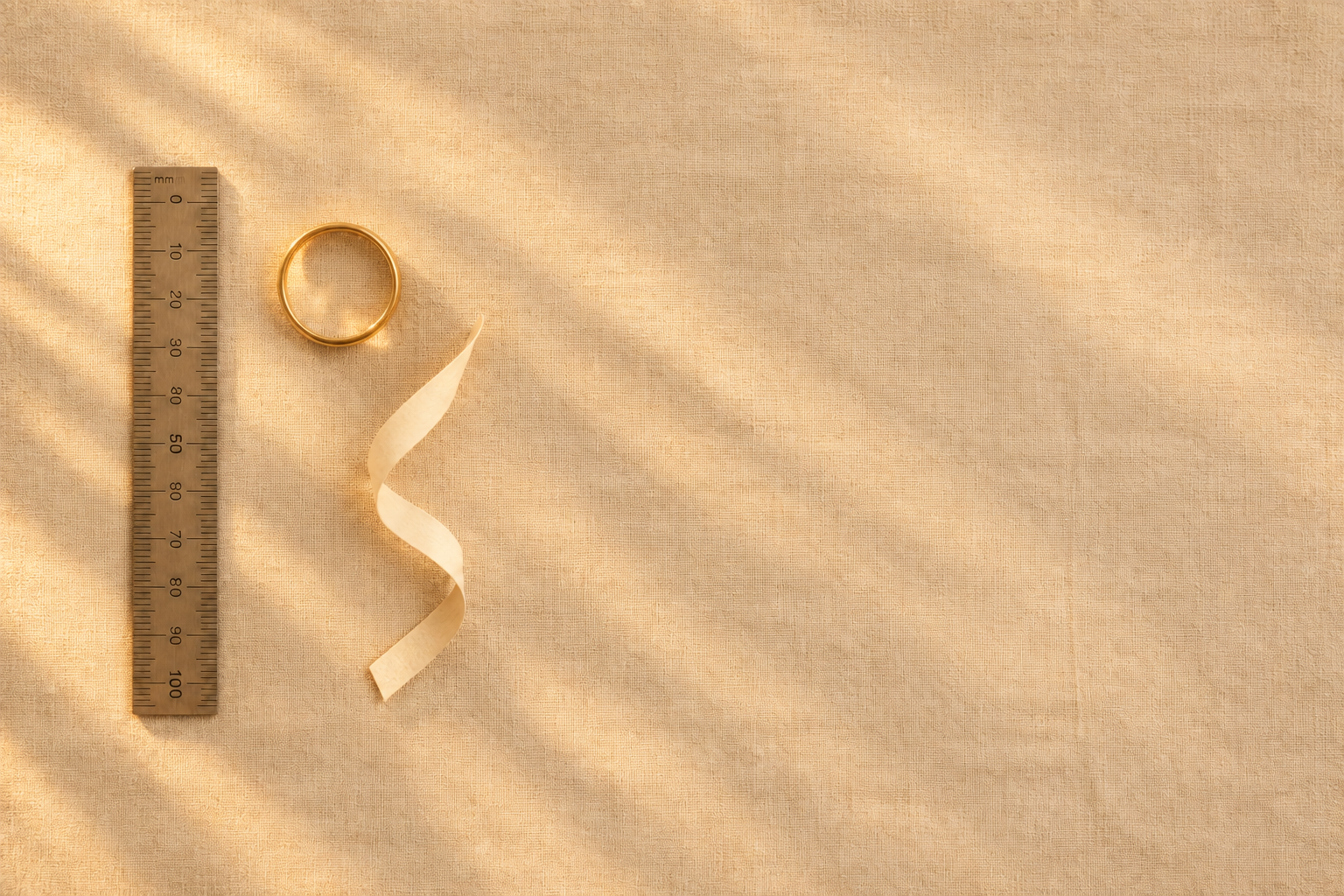
Take a ring she already wears on the correct finger. Measure the inside diameter across the widest point, from inner edge to inner edge, in millimeters. Use a ruler with millimeter markings, not inches, since fractions of an inch are too coarse for this.
Then match that diameter against the chart below.
Two cautions. Make sure you use a ring worn on the finger you are buying for, since fingers on the same hand differ by up to a full size. And measure the inside, not the outside, because band thickness will throw the number off by half a size or more.
If you can get the ring to a jeweler, better still. Most will measure it on a mandrel in under a minute at no charge.
The string or paper strip method
The fallback when no existing ring is available. It is less precise, but done carefully it gets within half a size.
- Cut a strip of paper about four inches long and no more than a quarter inch wide. Paper is better than string, since string stretches.
- Wrap it around the base of the finger, snug but not tight enough to compress the skin.
- Mark where the strip overlaps itself with a pen.
- Unwrap and measure from the end to the mark in millimeters. That is the circumference.
- Find the circumference on the chart below.
The step people skip is checking the knuckle. After marking the base of the finger, slide the loop up over the knuckle to confirm it will actually pass. If the knuckle is noticeably larger than the base, size to the knuckle and read the section on being between sizes.
Printable sizers and why they often fail
Printable ring sizers are the most common approach and the least reliable one, for a mechanical reason: printers scale.
Unless the print settings are set to exactly 100 percent with no fit to page scaling, the printed circles come out slightly small or slightly large, and the error is invisible. Most printable sizers include a reference line to check with a ruler. If you use one, measure that line first. If it is off by even a millimeter, the whole sheet is wrong.
Plastic ring sizer tools, the kind that work like a belt, are inexpensive and far more dependable. If you are buying more than one ring over time, one of those is worth owning.
Ring size conversion chart
US sizes with their corresponding inside diameter and circumference.
| US size | Inside diameter (mm) | Circumference (mm) |
|---|---|---|
| 4 | 14.9 | 46.8 |
| 4.5 | 15.3 | 48.0 |
| 5 | 15.7 | 49.3 |
| 5.5 | 16.1 | 50.6 |
| 6 | 16.5 | 51.9 |
| 6.5 | 16.9 | 53.1 |
| 7 | 17.3 | 54.4 |
| 7.5 | 17.7 | 55.7 |
| 8 | 18.1 | 57.0 |
| 8.5 | 18.5 | 58.3 |
| 9 | 19.0 | 59.5 |
| 9.5 | 19.4 | 60.8 |
| 10 | 19.8 | 62.1 |
| 10.5 | 20.2 | 63.4 |
| 11 | 20.6 | 64.6 |
| 11.5 | 21.0 | 65.9 |
| 12 | 21.4 | 67.2 |
For reference, the most common women's sizes fall between 5 and 7, and the most common men's sizes between 9 and 11. Those are starting points for a guess, not substitutes for measuring.
When to measure, and why it changes
The same finger is not the same size all day. Fingers swell with heat, salt, exercise, alcohol, and time of day, and they shrink in cold. The swing between a cold morning and a warm evening can be most of a full size.
Measure at the end of the day, at normal room temperature, when hands are neither cold nor swollen from activity. That reflects the size the ring needs to be comfortable most of the time.
Do not measure:
- First thing in the morning, when fingers are at their smallest
- Straight after exercise or a hot shower
- When hands are cold from outside or from air conditioning
- After a salty meal or a few drinks
Measure on two or three different days if you can, and use the number that comes up most often. Fingers also change over longer periods, with weight, pregnancy, age, and season, so a size from five years ago is a starting point rather than an answer.
How band width changes the size you need
This is the detail that catches people who have measured correctly and still end up with a ring that feels tight.
A wide band covers more of the finger and fits more snugly than a narrow band of the same nominal size. The general guidance is that a band wider than about six millimeters needs a half size up compared to a thin band.
The same applies to comfort fit bands, which are rounded on the inside and slide over the knuckle more easily. Those often run about a half size larger in feel.
If you are measuring using a thin ring she owns and buying a wider style, add the half size. If you are doing the reverse, do not.
Sizing a surprise gift without asking
The whole problem with ring gifting is that the reliable methods require the recipient's participation. Here is what actually works.
Borrow a ring
The best option by far. Take a ring she wears on the target finger, measure it or have a jeweler measure it, and return it before it is missed. If you cannot get it measured immediately, press it into a bar of soap or a piece of clay to capture the inside diameter and measure the impression later.
Ask someone who would know
A mother, sister, or close friend very often knows her size, or can find out without raising suspicion. This is the second best option and underused.
Use your own hand as a reference
Slide one of her rings onto your own finger and note where it stops. Show a jeweler that mark and they can estimate from it. Rough, but better than guessing blind.
Buy deliberately large
If none of the above is possible, size up rather than down. A ring that is slightly loose can be worn until it is resized. A ring that does not fit over the knuckle cannot be worn at all, and the disappointment lands on the day you give it.
The safest gift approach
If the ring is a surprise and you cannot get a reliable measurement, consider gifting a piece that does not require sizing, then choosing the ring together afterward. A personalized pendant or a bracelet carries the same meaning with none of the fit risk, and the ring becomes something you pick as a pair.
What to do if you are between sizes
Round up, in almost every case.
A ring slightly too large can be resized down, worn with a plastic ring guard, or simply lived with. A ring too small is either unwearable or uncomfortable in a way that invites taking it off, which is how rings get lost.
The exception is a finger with a knuckle much larger than the base. There, sizing to the knuckle leaves the ring loose at the base and prone to spinning. A jeweler can fit small sizing beads inside the band, which let it pass the knuckle and then hold position. That is the standard solution and it is not expensive.
Resizing after the fact
Both solid gold and sterling silver resize well, usually within two sizes in either direction without any visible change to the band. That is one of the practical advantages of working in solid metal, and one of several covered in our comparison of solid gold versus gold plated and sterling silver.
What resizes poorly:
- Plated pieces. The plating cracks at the join and needs replating afterward, which often costs more than the ring.
- Stainless steel. Its hardness works against the jeweler. Most will decline.
- Eternity bands and fully set rings. Stones run the whole way around, so there is nowhere to cut.
- Rings with engraving or cut out designs running around the band. Resizing interrupts the pattern.
That last point matters for personalized rings specifically. If a design wraps the band, getting the size right the first time is not just convenient, it is the difference between a piece that can be adjusted and one that cannot.
Frequently asked questions
How can I measure my ring size at home accurately?
The most accurate home method is measuring the inside diameter of a ring she already wears on the correct finger, in millimeters, then matching it against a conversion chart. If no ring is available, wrap a narrow paper strip around the base of the finger, mark the overlap, and measure the length for circumference. Measure at the end of the day at normal room temperature.
What is the average ring size?
Most women's ring sizes fall between US 5 and 7, and most men's between US 9 and 11. These are useful starting points for a rough guess but should not replace an actual measurement, since individual variation is wide and the wrong size on a made to order ring cannot be corrected after production.
Should I size up or down if I am between sizes?
Size up. A slightly loose ring can be resized, fitted with a ring guard, or worn as is. A ring too small will not pass the knuckle and is unwearable. The only nuance is a finger with a much larger knuckle than base, where a jeweler can add sizing beads inside the band to stop the ring spinning.
Does the time of day affect ring size?
Yes, significantly. Fingers swell with heat, salt, exercise, and alcohol, and shrink in cold, with a swing of close to a full size between a cold morning and a warm evening. Measure at the end of the day at normal room temperature, and ideally on two or three separate days.
How do I find out her ring size without her knowing?
Borrow a ring she wears on the target finger and have it measured, or press it into soap or clay to capture the inside diameter. Asking a mother, sister, or close friend is the next best option and works more often than people expect. If neither is possible, size up rather than down.
Does band width change the ring size I need?
Yes. A wide band covers more of the finger and fits more snugly than a narrow band of the same size. For bands wider than about six millimeters, go up a half size. Comfort fit bands, rounded on the inside, also tend to feel about a half size larger.
Are printable ring sizers accurate?
Often not, because printers scale pages. Unless printing is set to exactly 100 percent with no fit to page adjustment, the circles come out slightly wrong and the error is invisible. Check the reference line with a ruler before trusting the sheet. An inexpensive plastic ring sizer is far more dependable.
Can a personalized ring be resized later?
Solid gold and sterling silver both resize cleanly, usually within two sizes either way. Plated pieces resize poorly because the plating cracks at the join, and stainless steel is very difficult to resize at all. Rings with a design or engraving running around the full band are also limited, since resizing interrupts the pattern.
Why does my ring fit differently on different days?
Normal fluid variation. Heat, salt intake, exercise, alcohol, and time of day all change finger size, and cold has the opposite effect. Longer term, weight change, pregnancy, and age shift it too, which is why a size from several years ago is a starting point rather than a current answer.
How tight should a ring be?
It should slide on with light resistance and require a small amount of effort to come back over the knuckle. If it spins freely or slips off without resistance it is too large and at risk of being lost. If it has to be forced past the knuckle it is too small and will be uncomfortable when fingers swell.
Sized for One Person
Personalized rings in solid 14K gold and sterling silver, handcrafted to order in the USA.
Shop RingsJane Basch Designs has been designing personalized fine jewelry since 1988, born in New York and handcrafted today in our South Florida studio. Not sure about a size? Contact our team.